

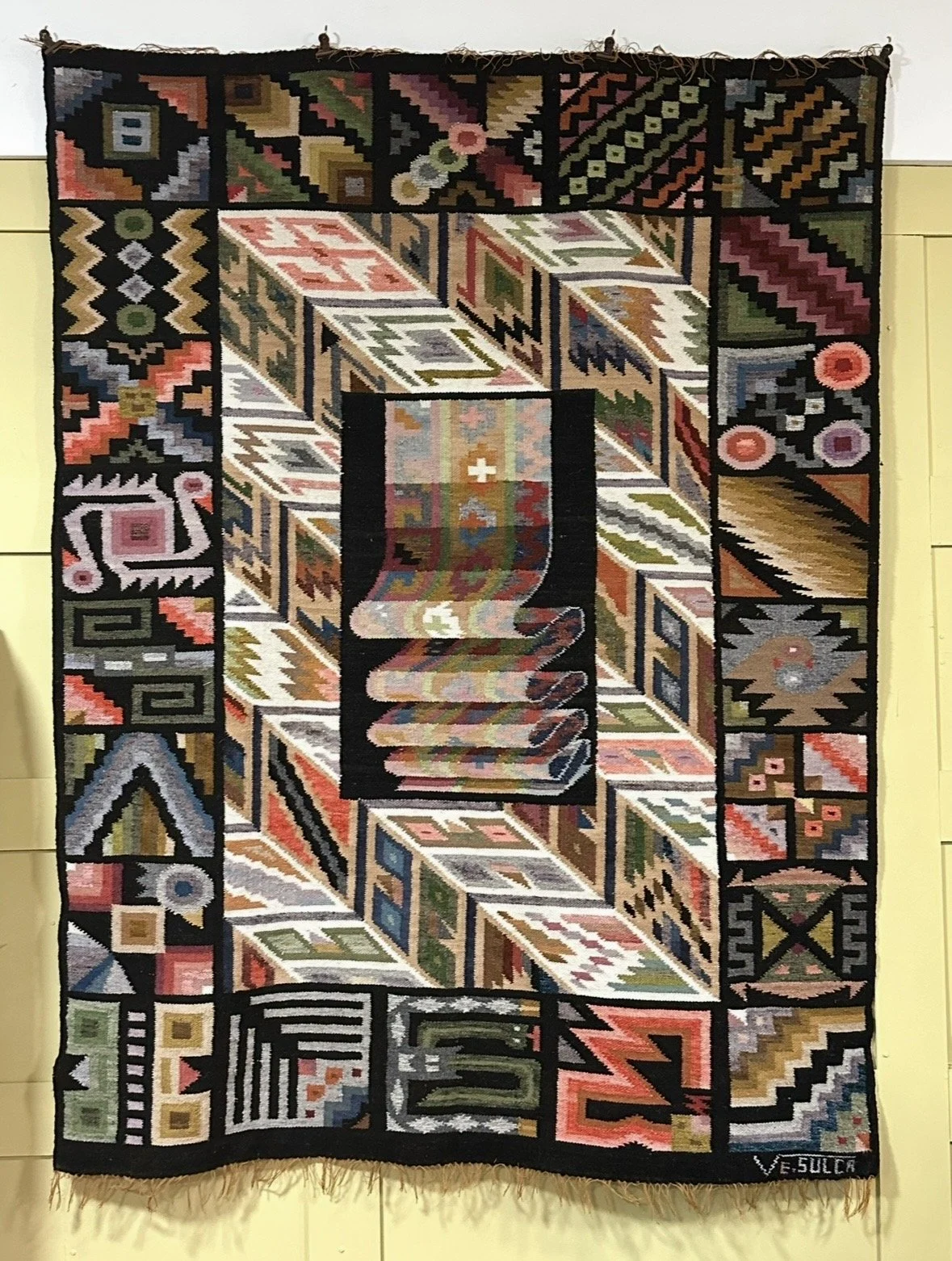
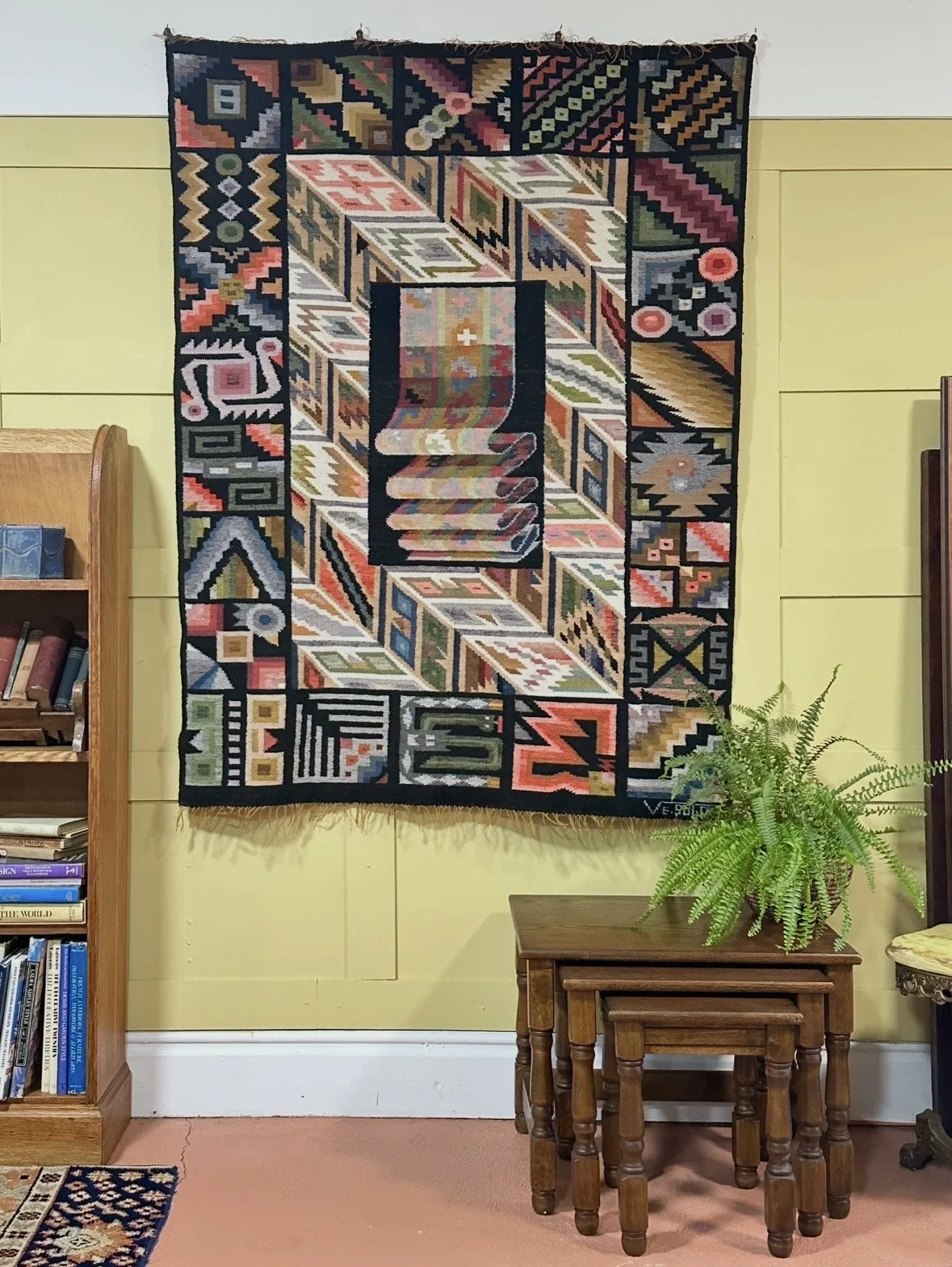
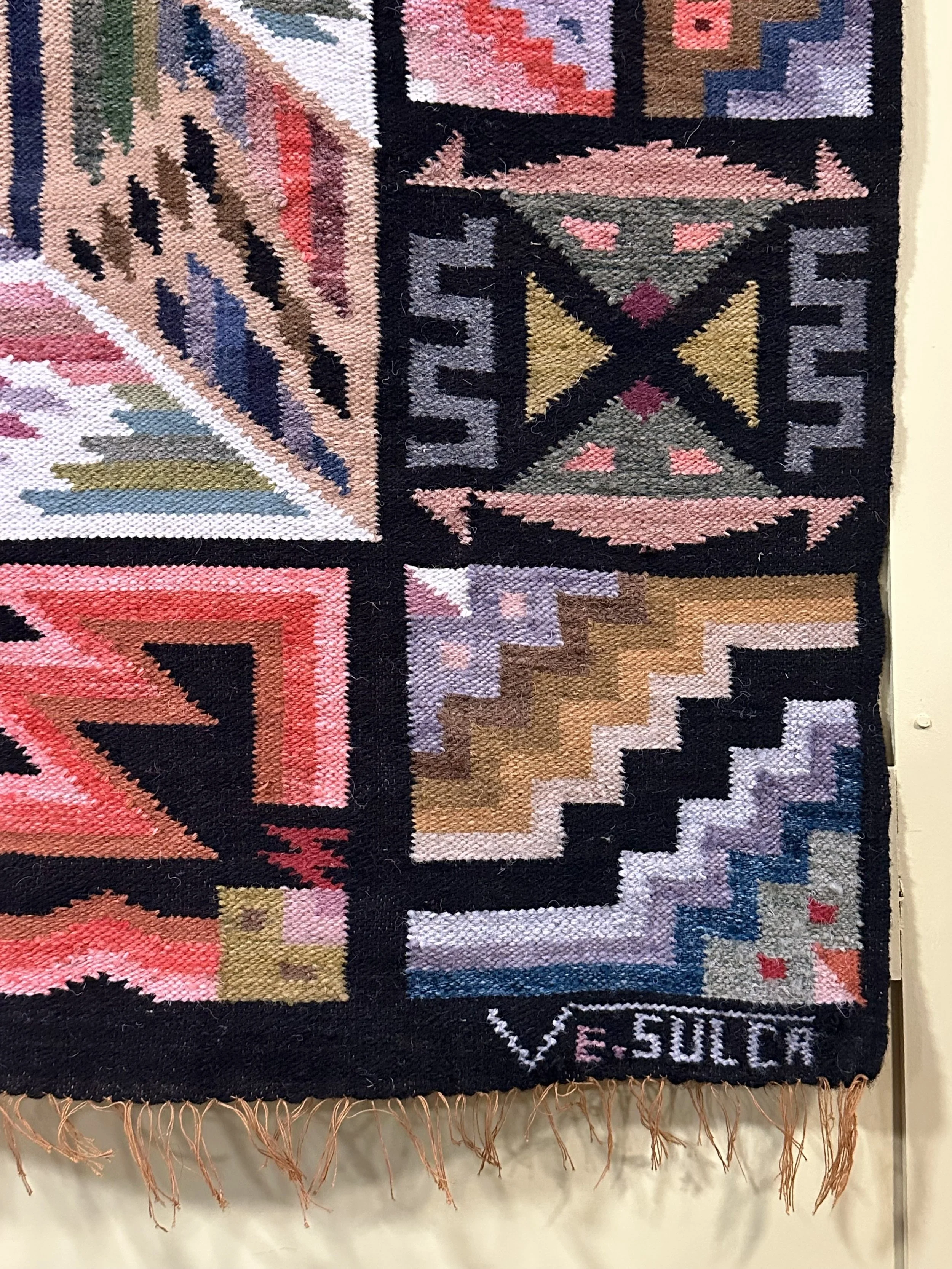
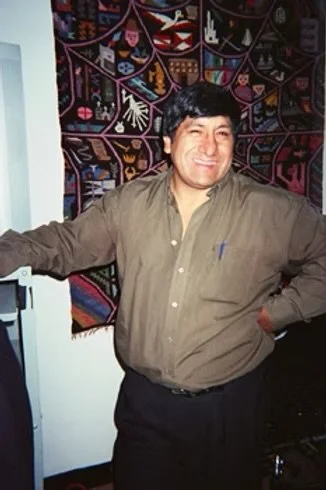
This incredible Peruvian tapestry is hand-woven, with a signature of V. E. Sulca, attributing it to Peruvian master weaver & artist, Victor Edwin Sulca (1945-2021). From our understanding, his father and fellow weaver, was also called Victor, which seems to be why the younger Sulca often goes by Edwin or Eddie. Signature usages by the two are generally either V.Sulca or V.E Sulca, with only a very small number signed E.Sulca- likely later in Edwin’s life.
Little is documented about Edwin’s father due to them living in a war torn country, but there is a lot of information about Edwin’s later life.
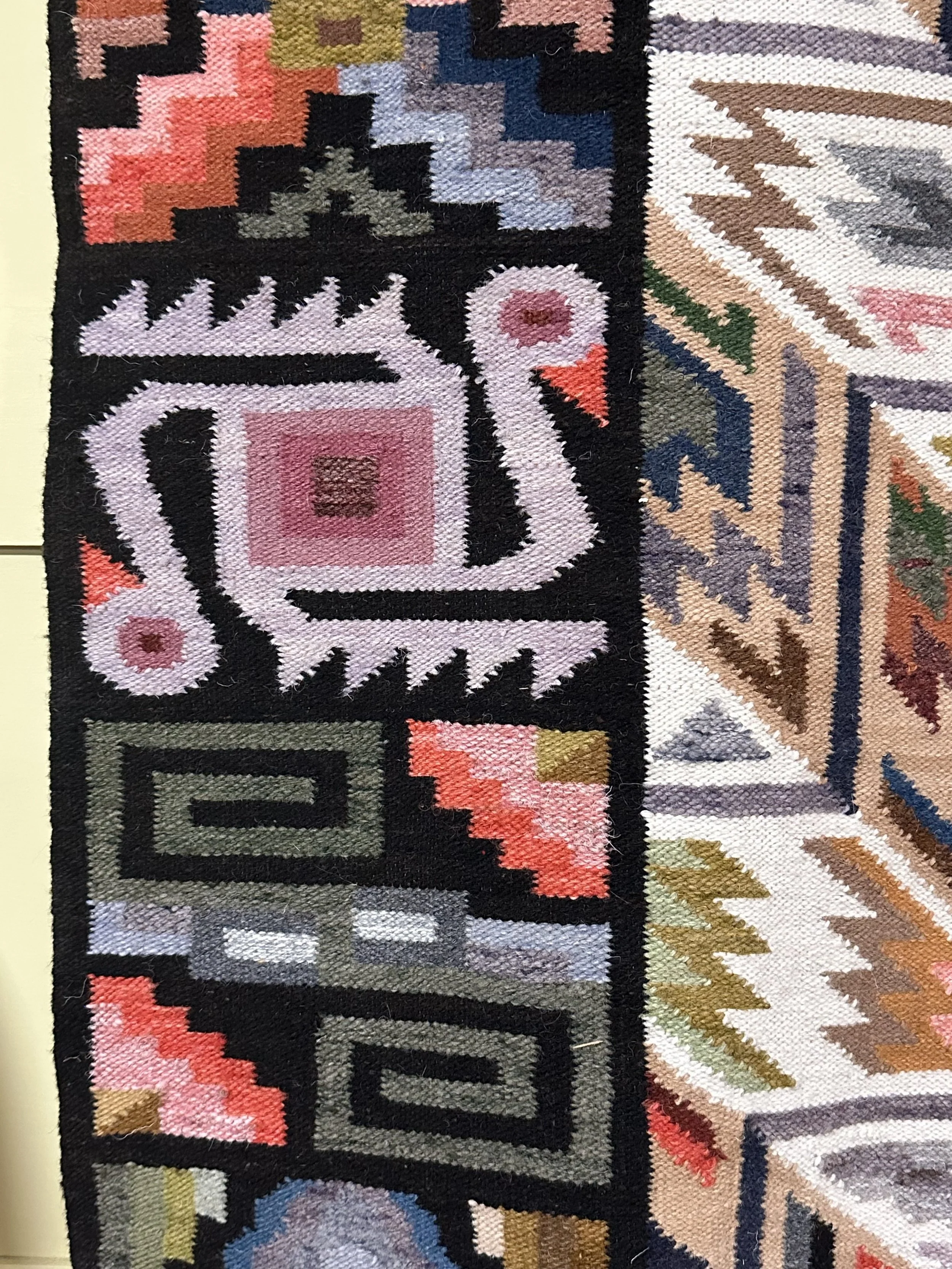
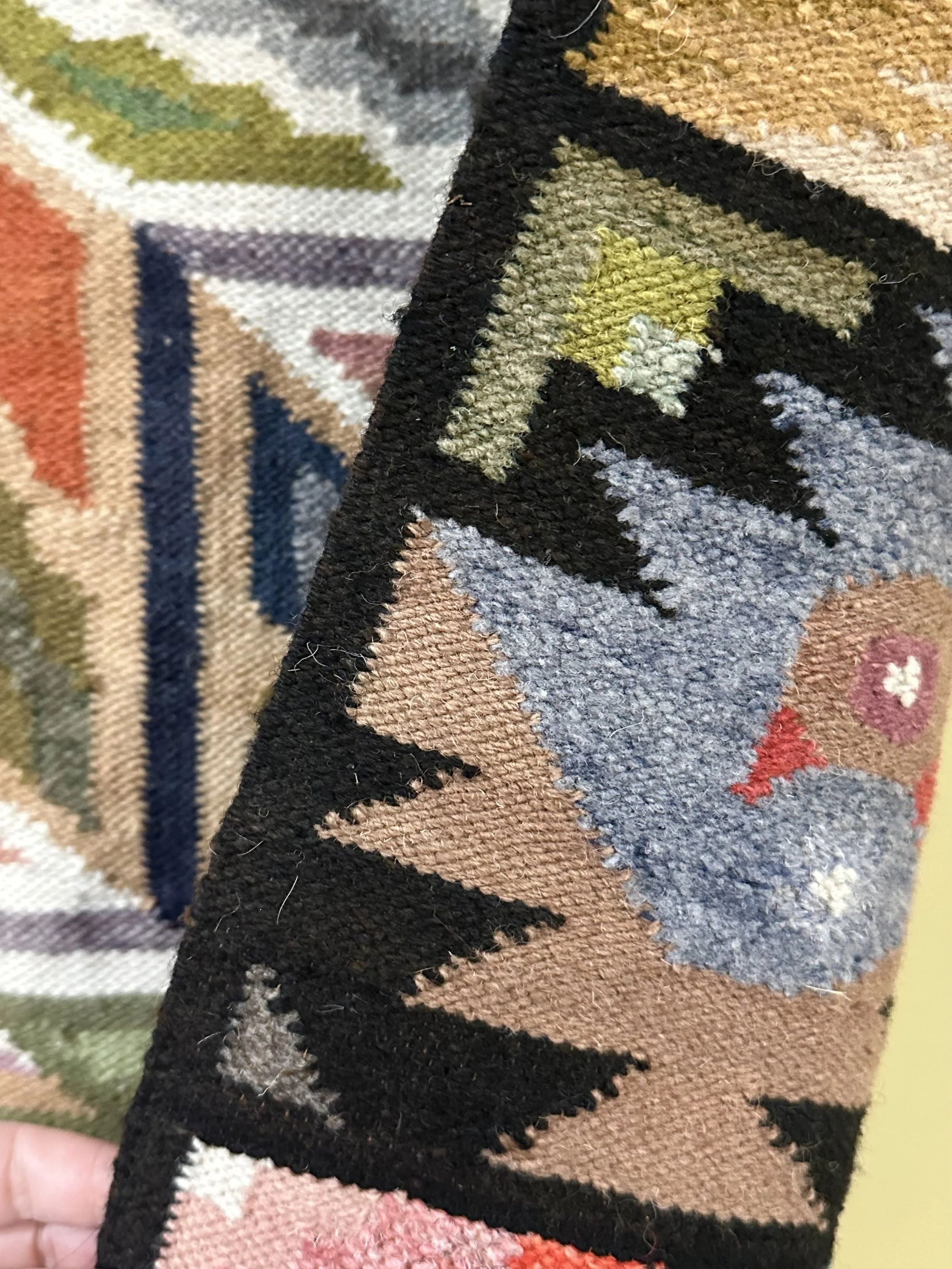
Edwin was a third generation master weaver, his Grandfather & Father were also master weavers. It was from them that Edwin learnt the "punto arwi" weaving method, a pre-Incan technique that involves twisting the yarn around the warp, or vertical thread, instead of just passing it through. Edwin’s tapestries are made of sheep wool dyed using a secret natural formula known only to Edwin and his wife, Gladys. Every year during the rainy season, Edwin and Gladys would walk for miles in the Andean Mountains to gather leaves, berries, branches, roots and insects. Using these natural ingredients, Edwin and Gladys would work together to produce dyes with subtle color effects that are unobtainable with synthetic chemical dyes.
Edwin was a native of Ayacucho, the Peruvian city which bore the brunt of the violent conflict between the government and the guerrilla movement Shining Path during the 1970s and ’80s. After more than twenty years of civil war, Sulca sought to incorporate the turbulent history of his city in the designs of his tapestries, but they also show its colourful revival into a more peaceful time.
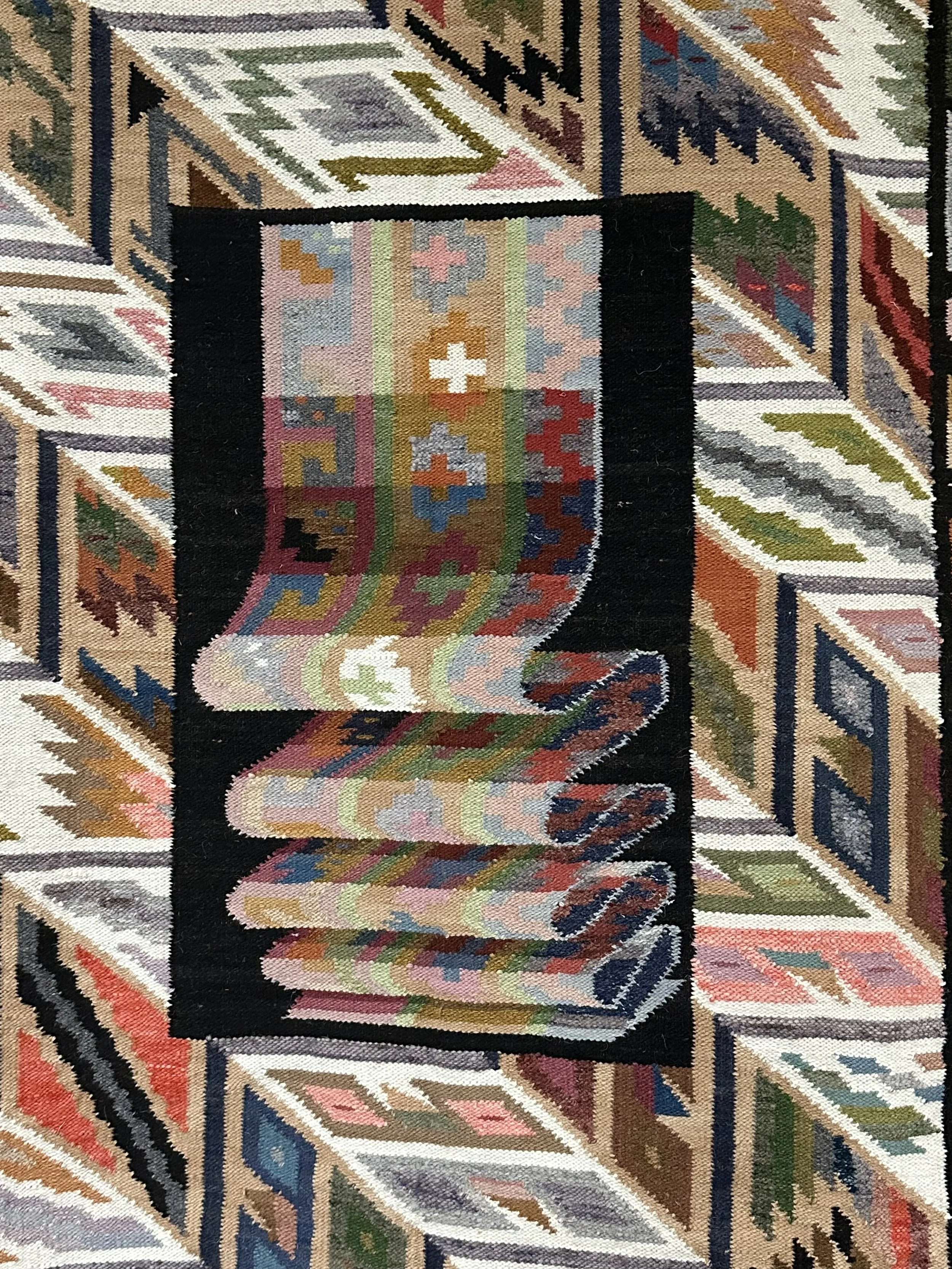
"Through the use of symbolic images in his weavings, he tells the story of his people," says John E. Rychtarik, curator of exhibits at the South Dakota Art Museum. "Although the weavings are very traditional, the symbolic designs and images, in many cases, create a very contemporary optical illusion."
The central 3D design in the tapestry has the appearance of a roll of fabric gracefully falling into a concertina fold. This imagery of animated fabric features in a number of Edwin’s designs, including one titled ‘Folding History’, suggesting the strong meaning behind it.
Edwin never made more than a few of each design, and even those of the same design would have variation in colours, making each tapestry unique. His earlier examples, are particularly rare, such as is this example.
The tapestry is signed on the bottom corner.
In great condition with minimal signs of age and wear.
Measures 155cm x 118cm.
This incredible Peruvian tapestry is hand-woven, with a signature of V. E. Sulca, attributing it to Peruvian master weaver & artist, Victor Edwin Sulca (1945-2021). From our understanding, his father and fellow weaver, was also called Victor, which seems to be why the younger Sulca often goes by Edwin or Eddie. Signature usages by the two are generally either V.Sulca or V.E Sulca, with only a very small number signed E.Sulca- likely later in Edwin’s life.
Little is documented about Edwin’s father due to them living in a war torn country, but there is a lot of information about Edwin’s later life.
Edwin was a third generation master weaver, his Grandfather & Father were also master weavers. It was from them that Edwin learnt the "punto arwi" weaving method, a pre-Incan technique that involves twisting the yarn around the warp, or vertical thread, instead of just passing it through. Edwin’s tapestries are made of sheep wool dyed using a secret natural formula known only to Edwin and his wife, Gladys. Every year during the rainy season, Edwin and Gladys would walk for miles in the Andean Mountains to gather leaves, berries, branches, roots and insects. Using these natural ingredients, Edwin and Gladys would work together to produce dyes with subtle color effects that are unobtainable with synthetic chemical dyes.
Edwin was a native of Ayacucho, the Peruvian city which bore the brunt of the violent conflict between the government and the guerrilla movement Shining Path during the 1970s and ’80s. After more than twenty years of civil war, Sulca sought to incorporate the turbulent history of his city in the designs of his tapestries, but they also show its colourful revival into a more peaceful time.
"Through the use of symbolic images in his weavings, he tells the story of his people," says John E. Rychtarik, curator of exhibits at the South Dakota Art Museum. "Although the weavings are very traditional, the symbolic designs and images, in many cases, create a very contemporary optical illusion."
The central 3D design in the tapestry has the appearance of a roll of fabric gracefully falling into a concertina fold. This imagery of animated fabric features in a number of Edwin’s designs, including one titled ‘Folding History’, suggesting the strong meaning behind it.
Edwin never made more than a few of each design, and even those of the same design would have variation in colours, making each tapestry unique. His earlier examples, are particularly rare, such as is this example.
The tapestry is signed on the bottom corner.
In great condition with minimal signs of age and wear.
Measures 155cm x 118cm.